Remembering Ted Cheskey
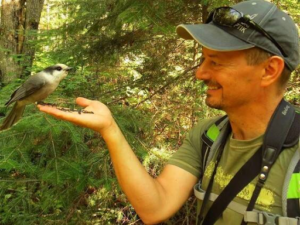
Birder, husband, father, grandfather, conservation leader, guitarist, karaoke singer extraordinaire – Ted Cheskey was an overflowing personality. Now that he’s gone, we can only echo what the 18th-century writer Charles Lamb said about one of his own departed friends: “When he left, he took half the fun of the world with him.”
That sense of fun was on display for many years at all-staff retreats, Christmas parties and field work – even on bleak November mornings in the office. Ted Cheskey filled his hours with days, cramming as much living ( and laughing) into his life as possible. He was more than a mentor and colleague; he lifted spirits and jump-started morale. We could have organized half an hour of laughter yoga every week as a corporate wellness initiative, but why bother? We had Ted.
We don’t know what Ted’s “spark bird” was (the species that initiates a person’s interest in birding), but it is fair to say that almost every kind of bird sparked some emotion in him. He grew up in Toronto and then Milton, Ontario, where he began exploring the outdoors. It was in these places, no doubt, that he began training his eye and ear to identify birds (and perhaps training his voice for karaoke). He went on to do undergraduate and graduate degrees at the University of Waterloo in environmental studies, regional planning and resource management. His master’s thesis, “Planning for the Birds,” was based on two years of field work to assess the impacts of urbanization on breeding forest birds along a 20-kilometre forested river corridor in Southern Ontario.
Birds were both a vocation and avocation for Ted. In 2001, he co-founded the Bruce Peninsula Bird Observatory in Ontario and served as its president for nine years. He was a member of the Technical Advisory Committee and Publication Committee for the first two Ontario Breeding Bird Atlases as well as a contributing species author. He contributed to Canada’s landmark State of the Birds Report (2012 and 2019) and to the State of North America’s Birds: 2016.
When he started at Nature Canada full-time in 2006, Ted was ready to take on the world – and make it a better place for wildlife. He was the driving force behind the creation of Bird Friendly Cities, Nature Canada’s national certification standard to certify municipalities as bird-friendly. As of October 2026, the program has certified 41 cities and towns across Canada. The Bird Friendly City program was inspired by the Urban Bird Treaty and the Wisconsin Bird City program, but Ted and his team made it uniquely Canadian. For the five-plus years of its existence, it has focused on restoring nature and important bird habitat, engaging residents to explore nature and celebrate birds, and addressing key threats to birds such as cat predation, collisions with glass, light pollution, pesticides, and climate change.
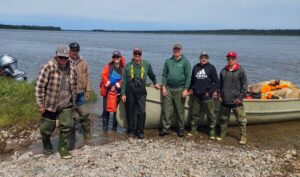
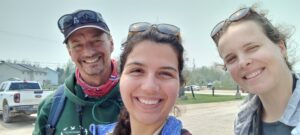
Lately, Ted spearheaded Nature Canada’s Save our Shorebirds initiative. The idea here is simple: if we are to save migratory shorebirds, we have to range as far as they do. “Save our Shorebirds” engages communities, including traditional and Indigenous communities, along continental flyways, to protect and maintain stopover habitat for shorebirds. A big part of this work involves adapting and applying the Discover Shorebirds curriculum (created by the Western Hemisphere Shorebird Reserve Network) in local schools in James Bay and Lagao do Peixe, Brazil. Migratory shorebirds are citizens of the world, and that means conservationists have to be, too. Ted and the rest of the stalwart Naturalist team – Lara Falkiner and Priscilla Santos – have connected communities across continents, bringing together classes of schoolchildren through Zoom and facilitating visits by Indigenous elders to South America.
Ted was gifted in languages, having learned in his lifetime Spanish, Portuguese and French. “My knowledge of and interest in birds boosted my language learning curve, “ he wrote. “Whenever I travel, I try to learn some of the bird names in the local language. I’ve even learned some bird names in the Cree dialects spoken around James Bay in Northern Ontario and Quebec, where I’ve been fortunate to work.”
That last sentence reveals another aspect to Ted; his belief in Indigenous conservation as a path to Reconciliation. He was one of the handful of bird experts in Canada who, through his work with Indigenous partners, contributed both to international protection and monitoring of migratory birds as well as to Indigenous conservation. He knew that Indigenous peoples have not been a part of mainstream bird conservation efforts and, in every aspect of his work, he sought to bring them in. This included everything from incorporating an Indigenous requirement of Bird Friendly City applicants to facilitating access to project funding for Indigenous groups.
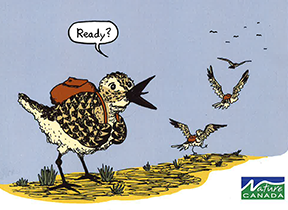
As part of his decades-long work with the Cree of James Bay, Ted created educational comic books that dramatized the natural history of endangered migratory shorebirds; one of these, A Year in the Life of a Red Knot, has been published in three Cree dialects as well as English, French, Portuguese, Spanish and Dutch. A second comic, The Story of Bico, about a Hudsonian Godwit, is being translated into Moose Cree, French and Portuguese.
“On the death of a friend,” wrote the 19th-century writer and naturalist Henry David Thoreau, “we should consider that the fates through confidence have devolved on us the task of a double living, that we have henceforth to fulfill the promise of our friend’s life also, in our own, to the world.” We offer our heartfelt condolences to Ted’s family, but at the same time, assure them that his legacy will live on – he has so many friends to carry it forward.
Goodnight, Ted; we hope the owls are hooting and the nighthawks calling and the whippoorwills whippoorwilling as you take your leave. They surely recognize a friend and champion.