Storyteller into Orca
October is a month of transition and change, with Halloween offering the chance to dress up and leave our workaday roles behind. What better time to become a whale?
I’ve always believed in personal transformation and the value of seeing things from another perspective. And whales have a unique way of experiencing the world. In Canada we have over forty species of whales, dolphins and porpoises (they all belong to the order Cetacea). These range from the blue whale, which can reach 30 metres in length, to the harbour porpoise, which is usually under 1.8 metres.
For my transformation, I think I’ll choose an in-between whale – the orca ( or ḴEL,ȽOLEMEĆEN to the W̱SÁNEĆ people of BC). These animals belong to the category of toothed whales (the other kind of whale, the baleen whale, has plates of baleen or “whalebone,” to seive in plankton). Orcas are usually between 6 and 9 metres long. Manageable, for a first effort at shapeshifting.
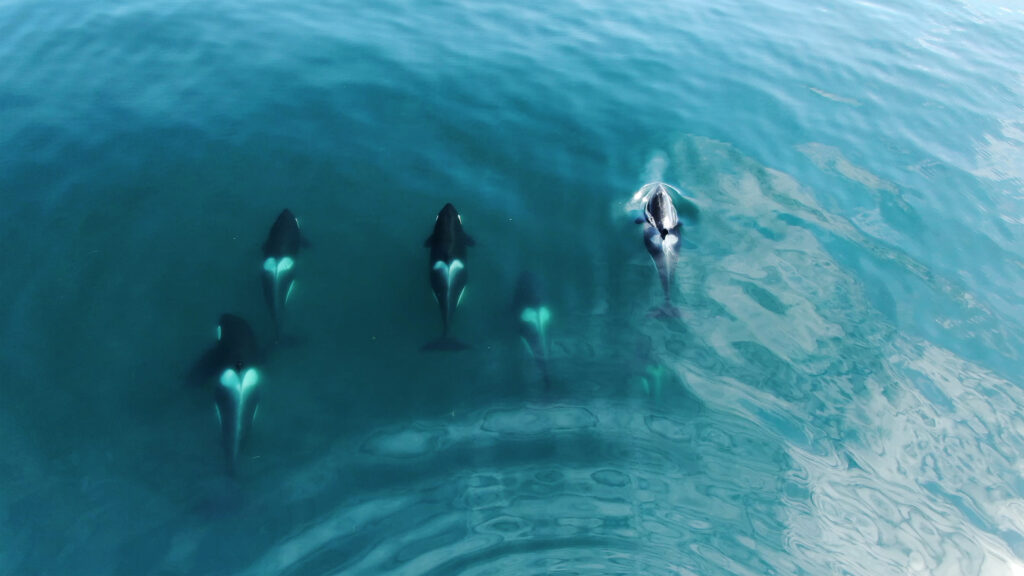
To the W̱SÁNEĆ people of BC, ḴEL,ȽOLEMEĆEN (orcas) are considered family members and guardians of the people.
The good news is that I’m already half way to my transformational goal. Like an orca, I’m a warm-blooded mammal that can swim underwater and hold my breath. In my hand, I have five jointed finger bones; an orca has the same configuration in its flipper. An orca can live up to ninety years, like humans. And orcas have complex social and emotional lives, just as humans do.
Still, some things are going to be a challenge. For example, I’ll have to learn to sleep with one brain hemisphere awake – which means one eye open. Orcas, like many other marine mammals, sleep a semi-conscious sleep, where part of their brain is resting while the other part is alert to their environment.
In preparation for this challenge, I’ve tried practicing this new kind of sleep at work meetings, with limited success. “Findlay’s doing uni-hemispheric sleep again!” say my colleagues, sometimes loudly enough to wake up my snoozing brain hemisphere. They don’t realize that I’ve heard everything that’s been said from the start of the meeting. That’s the survival value of uni-hemispheric sleep; an animal can rest while still being aware of potential threats around it.
But breathing through the top of my head – that’s a really tough one. An orca has a blowhole, of course, which it can open and close at will in order to breathe. Again, I’ve tried imagining this process during work meetings, and even gotten so far as to make some reasonably convincing whale exhalations, but this can make my teammates uneasy. And I’m already looking at them with only one eye.
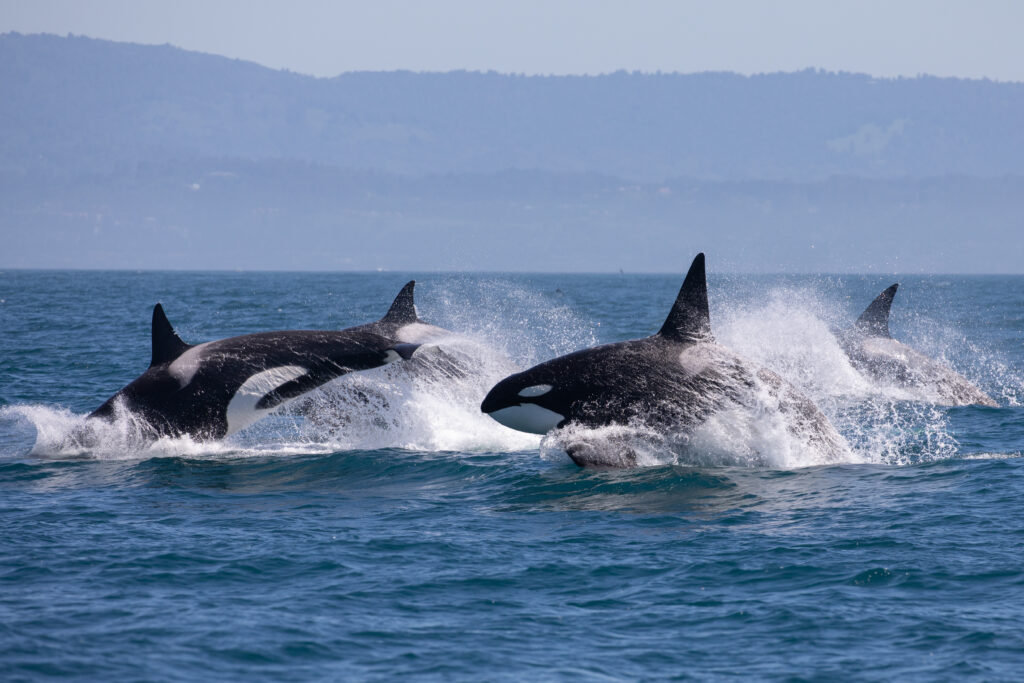
But now, after plenty of research and mental preparation, I feel I’m as ready as I’ll ever be for the transformation. The actual technique is one that all kids know, but adults often have to relearn. Find a quiet, safe place. Turn off all devices. Now close your eyes and, in your mind, put on the form of an orca…
I feel my body elongate and grow thicker (blubber is accumulating, but the good kind). My arms and legs shrink, but my hands expand to become flippers. Now I’m in salt water, swimming ten metres below an untidy ceiling of massed bull kelp. The sunshine comes down in slanted columns of spearmint light. I realize that I have some extra senses to go with my ability to sleep with one brain hemisphere awake. I can send out clicks of sound from my jaw, which give back echoes and so create the shapes of objects in my mind. Orcas have a method of seeing sound, called echolocation, which they share with bats and other toothed whales.
But the ocean is noisy! BC’s coastal waters are some of the busiest in Canada, and vessels are a danger not just because of the collision risk – their engine noise interferes with whales’ ability to communicate and navigate. I go a bit deeper, to get away from the noise. How fast can I swim? Let’s see! Yes, that’s fast – over 30 kilometres an hour, I’m estimating, faster than the best human sprinter.
But I think I need a breath. Rising, I feel the waters divide and slide off my back. The sun shining through the mist of my exhalation creates a faint rainbow. A nice effect for the photographers, if there are any around, and there probably are – I know I’m photogenic. And there’s land not far off…
Land. That bumps me out of my transformation and back into my human form. Must be something in my evolutionary background.
Though it was short-lived, I feel that my thought experiment was a success. As kids know, putting on the mind and form of another animal is fun – and a good way to become a better citizen of the earth. I can hardly wait until World Octopus Day.
Federal and provincial governments are advancing policy changes that could weaken protections for species at risk, including orcas. Tell your MP that Canadians do not support rolling back environmental safeguards in the name of economic development!
Want to help Canadian species and spaces? Stay tuned with the latest in Canadian nature by subscribing for email updates. You’ll receive regular updates about what we’re doing to protect Canadian nature and how you can help.