Announcing the 2026 Charles Labatiuk Scholarship Award Winner: Mandy Gibson
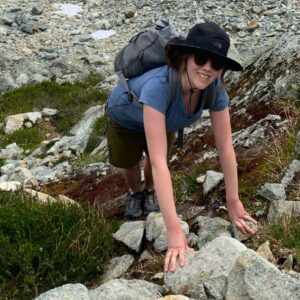
The following winning essay was written by Mandy Gibson, the 2026 Charles Labatiuk Scholarship Award Winner.
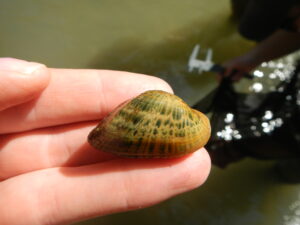
Growing up, I was the wildlife-obsessed kid, wondering about everything in the natural world. Fortunate to have a family cottage, I loved exploring and finding wildlife in the Kawartha Lakes. Frogs, fish, and fireflies – my siblings and I spent hours searching for them all. But most of all, I marveled at the freshwater mussels I found in the lake. I would collect them in a bucket and watch their siphons suck up the water, before bringing them back to their home at the bottom of Canal Lake. This sparked my interest in studying ecology.
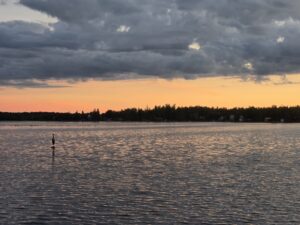
In 2013, I enrolled at the University of Guelph. I became active in research by volunteering in two labs, Dr. Ackerman’s lab and Dr. Boulding’s lab, completing a work study in the latter in my third year. In the summer of 2016, I enrolled in a field course in New Brunswick, studying the intertidal zones in the Bay of Fundy, and completing an independent project studying the righting response time of sea stars under hypoxic conditions. And finally, the “capstone” course required to complete my Honour’s BSc in Marine & Freshwater Biology; I completed a group project studying marine mussels’ impact on nitrogen loading. In 2015, I landed a summer job with Fisheries and Oceans Canada (DFO) on their Mussel Species at Risk (SAR) field team, the position that launched my career and passion for species at risk science.
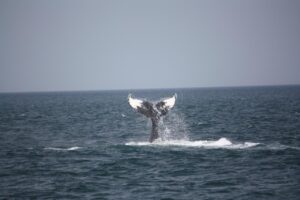
I graduated in 2017 and worked a variety of contracts, starting in the Fish Culture section with the Ontario Ministry of Natural Resources (MNR), and later with their Lake Erie Management Unit. I also lived in two unique parts of Canada when I worked at an MNR hatchery on Manitoulin Island for a winter, and when I worked on a whale watching boat in St. Andrews, NB. I experienced a sea lamprey try to latch onto my arm when I worked for Toronto and Region Conservation Authority, monitoring and removing over 900 invasive sea lamprey from the Humber River and Duffins Creek.
I worked many contracts with DFO before securing a term position in 2022. I exceeded goals for three field seasons, leading the team in rivers across southern Ontario. I led the crew through the third round of monitoring for a 25-year dataset on freshwater mussels in the Sydenham River, a mussel hot-spot in Canada. We snorkelled in the Ottawa and Mississagi rivers in search of Hickorynut mussel, and also worked with divers to find the species in deeper waters. Glamorously, my team and I searched many mucky-bottomed rivers in search of the Lilliput mussel. I received an award from DFO’s SAR Program for my research contributions to inform the Committee on the Status of Endangered Wildlife in Canada (COSEWIC) assessment of this species. Moreover, I developed many skills including writing reports and publications, and analyzing data using R.
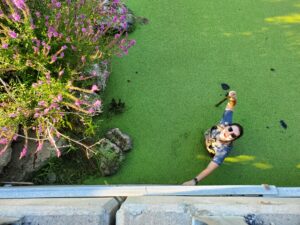
Unfortunately, my time at DFO came to an end in 2025. Due to budget cuts, my term contract was shortened, and I was not able to be extended in the SAR team. As I look back on this, I know it was all for the best – I needed to take the leap, make the next step in my career, and pursue a Master’s.
I am entering the Master’s program at University of Toronto Mississauga in the Department of Ecology and Evolutionary Biology. My advisor is Dr. Kara Layton, an expert in conservation genomics. My goal is to integrate genomic tools and ecological modeling to determine genomic variation and predict climate change response in populations of the Snuffbox mussel, an endangered species in Canada. This will help decision makers prioritize areas to protect Snuffbox populations for the future.
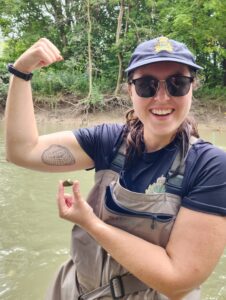
Snuffbox is incredibly unique, and there is a reason I have a tattoo of the female Snuffbox on my arm. All unionid mussels, the native ones, are obligate parasites. Their larvae must attach to the gills of a fish (or in one case, a Mudpuppy) in order to metamorphose. The Snuffbox has adapted to give its young the best shot. The female Snuffbox sits in the riverbed, unassumingly, until a Logperch comes along looking for food. Logperch use their little snout to upturn rocks, searching for invertebrates to snack on. When it mistakes a Snuffbox for a rock, the female clamps shut on the poor fish, and pumps its glochidia (larvae) into its face. The glochidia have a much higher chance of coming into contact with the gills, and snap their tiny little shells closed on a gill filament, hanging on and taking in nutrients from the fish. They grow into juvenile mussels, still very small, and drop off into the sediment to grow some more. Eventually, after filtering food from the water for many years, they grow into adults and the cycle continues.
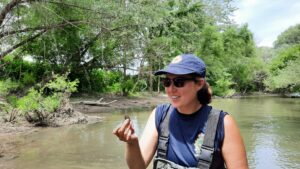
In addition to their unique lifecycle, freshwater mussels are important to protect because they are filter feeders – they are clear indicators for when water quality is no bueno! We have 41 species in Ontario, with a hotspot in southwestern Ontario. The Sydenham River is home to much of the diversity in Ontario: within a single musselbed, you can find over half of the species in Ontario within an area smaller than a hockey rink!
With my Master’s, I hope to protect the most unique and vulnerable species. I aim to become a conservation expert and use genomic tools to research taxa that are often overlooked. This summer, I am working for Couchiching Conservancy, Orillia’s land trust, and it’s opened my eyes to the world of land conservation. I have developed an interest in the Carden alvar, which is in the “backyard” of my cottage. Alvar habitat is very rare and supports grassland birds which have been steeply declining. Although my passion for mussels is strong, I plan to utilize my education to protect species from a variety of habitats. I strive to become a leader in Canada to aid in the growth of genomics as a widely-used tool in conservation.