Living the High Life: A Peek at Mountain Goats
Thanks to our Nature Network partner Nature Alberta for providing this month’s blog.
Up on the high rocky peaks where few large animals dare to tread, the mountain goat makes its home. One of Canada’s most unique wildlife species, this hardy mountaineer is one of the classic symbols of the rugged high country of the west.
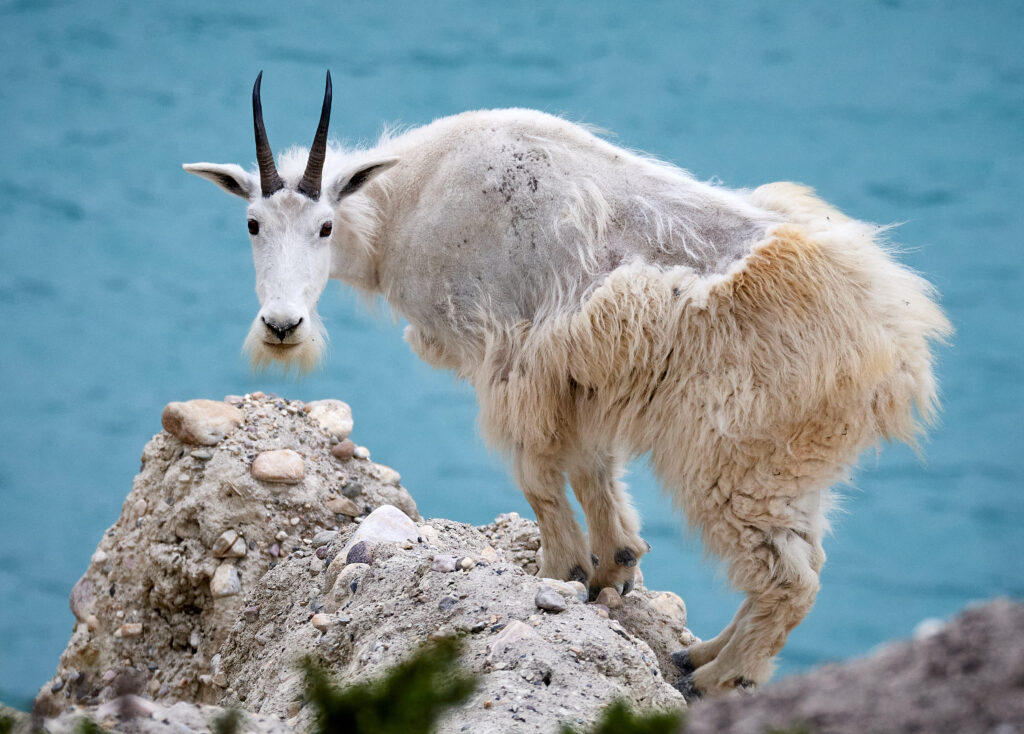
Mountain goat (Photo: Archie Richardson)
The ‘Goat’ That’s Not a Goat
Not much in the Canadian wilderness looks like a mountain goat, making them easy to identify at a quick glance. Mountain goats (called Matx by the Nisga’a Nation of western British Columbia ) are even-toed ungulates in the same Order of mammals as deer, camels, pigs, cattle, and even whales. Adults are about 1.5 metres long, around a metre tall at the shoulder, and weigh from 45-135 kilograms. They are stocky-looking animals with stout legs and shoulders. The all-white fur of mountain goats is long and shaggy in the winter to protect them from harsh mountain weather, but falls off in clumps in June, revealing the much shorter summer coat (see photo above). Both adult males and females have conical black horns that taper to sharp points; in males they’re thicker and more evenly curved. The hooves have a rough-textured pad under the hard outer layer, which helps the animals to grip the rock and climb sheer surfaces.
The long face, beardy chin, and horns give these animals a very goat-like appearance. But don’t be fooled by the look or name of this animal. While mountain goats and “true goats” like what you’ll find on a farm do belong to the same ungulate group, the Caprinae subfamily, “true goats” in the genus Capra belong to a slightly different branch on the family tree than mountain goat in the genus Oreamnos. The closest living relative to mountain goats is the takin, a large horned animal from eastern Asia. Some people refer to bighorn sheep as “mountain goats,” but bighorns are indeed true sheep.
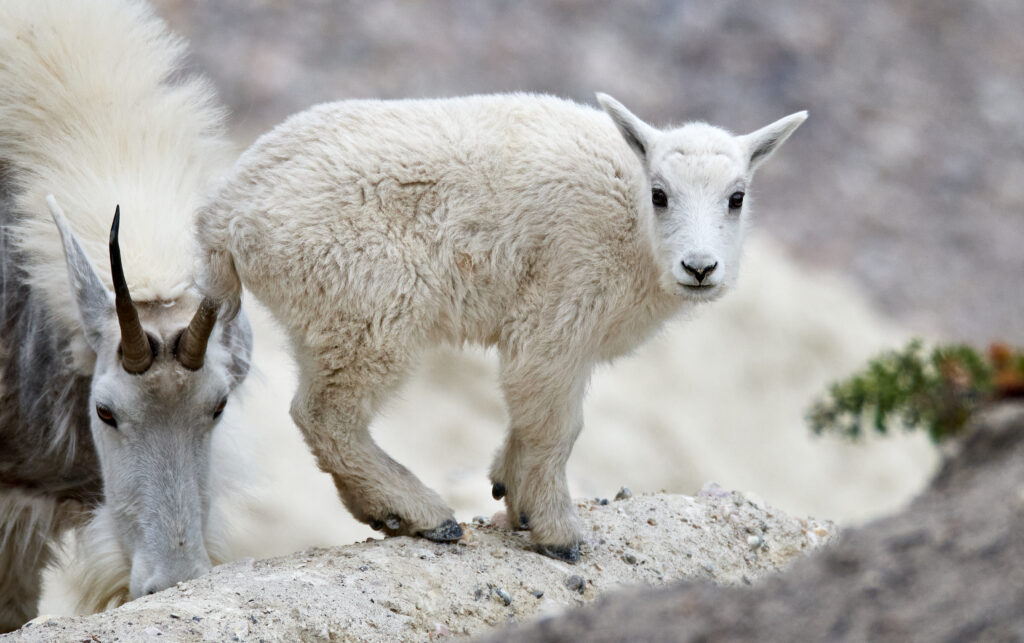
Mountain goat nanny and kid. Photo: Archie Richardson
Life on Top of the World
True to the first half of their name, mountain goats live in mountainous regions. In Canada they’re found from the Alberta Rockies west of the foothills all the way to the Pacific coast, and as far north as the southern Yukon and western Northwest Territories. They generally live at higher elevations than most other animals of their size, keeping to the upper alpine meadows and rocky summits above the treeline where they feed largely on grass as well as shrubs and lichens.
Unlike bighorn sheep, mountain goats are not very social animals. Outside the fall rutting season, the males, also known as “billies,” spend their time alone. Female or “nanny” goats form loose herds, but they can be highly protective of their space. The young, or “kids,” are born in late spring, reach sexual maturity at just over 2 years old, and will live for about 12-15 years.
Few predators can easily access mountain goats in their preferred habitat; cougars occasionally make it up to take the odd individual, and Golden Eagles will prey on young goats. Some of their biggest dangers, however, are falls and avalanches. Despite their climbing abilities, mountain goats do occasionally misstep on cliffs, with fatal consequences. Unlike most other ungulates, they stay at relatively high elevations during the winter, and sudden avalanches during this time can take unfortunate goats unawares. Sometimes, though, mountain goats have to reluctantly descend to lower elevations where they are vulnerable to other predators like wolves, grizzly bears, and black bears.
Why do they descend from the heights? The answer is minerals. To produce the keratin of their hair, horns, and hooves, the animals need chemicals that aren’t found in their regular diet, namely sulphur, selenium, and a bit of salt. To obtain these, they travel several kilometres down to particular rock exposures, where these minerals can be found, to lick the rock to ingest what they need. They may return to traditional ‘goat-lick’ sites over and over again. A few of these are at convenient points along the highway in Jasper National Park, where goats can be observed getting their minerals.
Keeping Our Goats Afloat
The conservation status of the mountain goat is listed as “Secure” in Canada, and fortunately the part of its range that falls within Alberta is largely protected as national and provincial parks. However, given the specialized lifestyle of this species, it’s important that mountain goat habitat is kept intact to ensure they can continue to thrive.
Nature Alberta contributes to the ongoing conservation of species like this in different ways. Our citizen science initiatives, such as the Alberta Biodiversity Challenge, encourage Albertans to submit their wild species sightings to iNaturalist. This in turn contributes important data to help us understand the distribution and abundance of species throughout the province. We also advocate for initiatives that protect nature including the ongoing protection of Alberta’s Rocky Mountains, the only place in this province where these rugged mountain animals can be found.
Want to help Canadian species like mountain goats and more? Stay tuned with the latest in Canadian nature by subscribing for email updates. You’ll receive regular updates about what we’re doing to protect Canadian nature and how you can help.