
Although it is not within the scope of this toolkit to provide an in-depth exploration of data collection and analysis best practices, the Ontario Human Rights Commission has produced an excellent document on human rights-related data that is generally appropriate for use across Canada. Please see their Count Me In! Collecting Human Rights-Based Data for a full set of steps and considerations.
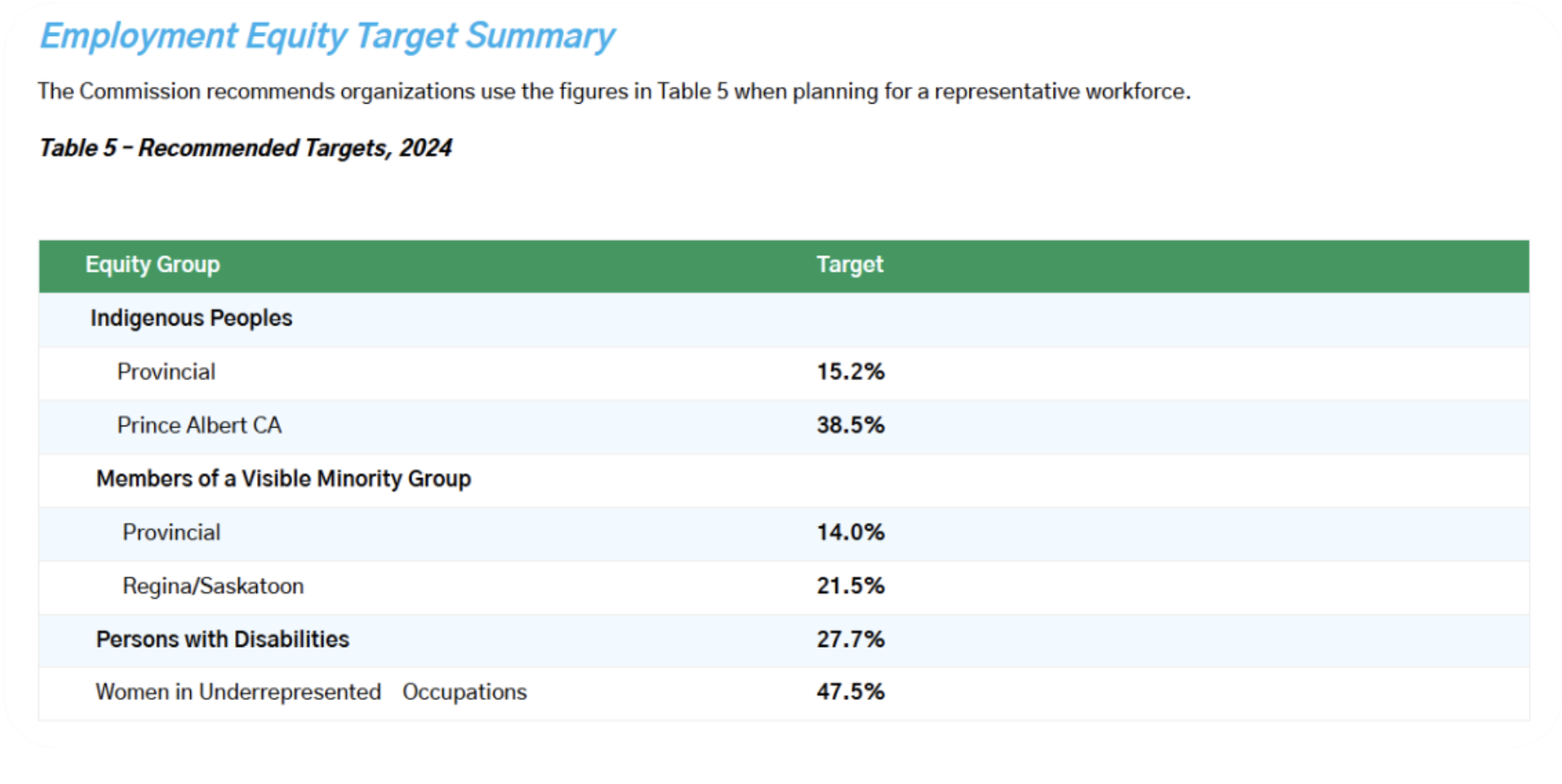
The Saskatchewan Human Rights Commission has taken the extra step of providing employment equity targets for the four designated equity groups which reflect the ideal workforce representation of visible minorities, Indigenous persons, people with disabilities, and women in underrepresented occupations. Based on national 2021 census data (with support from the Saskatchewan Bureau of Statistics), these metrics are a benchmark for employers to evaluate their efforts to recruit and retain employees in the four equity groups.
It is not sufficient to meet equity targets through the employment of equity group members in entry level positions only. Over time, the recruitment, retention, and promotion of employees within an organization should reflect the true picture of diversity in our society. SHRC
Saskatchewan Employment Equity Targets
Equity targets in Saskatchewan also recognize that they need to vary by location. For example, there are more people who are visible minorities in Regina and Saskatoon than other parts of the province, so the targets for visible minorities are higher in these two cities. Similarly, the targets for the Indigenous population is higher in the Prince Albert Census Agglomeration (CA) where there is a proportionally larger Indigenous population.
For more information on how Saskatchewan has set their targets for the four identified equity groups using external data, please consult this link and view the Employment Equity Targets section.