

"Employment equity is not optional for Canada. For a society that is as deeply diverse as ours to flourish, we must prioritize achieving and sustaining employment equity in the workplace.” Adelle Blackett, A Transformative Framework to Achieve and Sustain Employment Equity, Page 2
Employment equity ensures that all people in Canada have equal opportunities to employment in workplaces that are free from discrimination. Essentially, employment equity is about the actions an employer takes to ensure conditions in a workplace do not exclude or discriminate against some workers and job applicants.
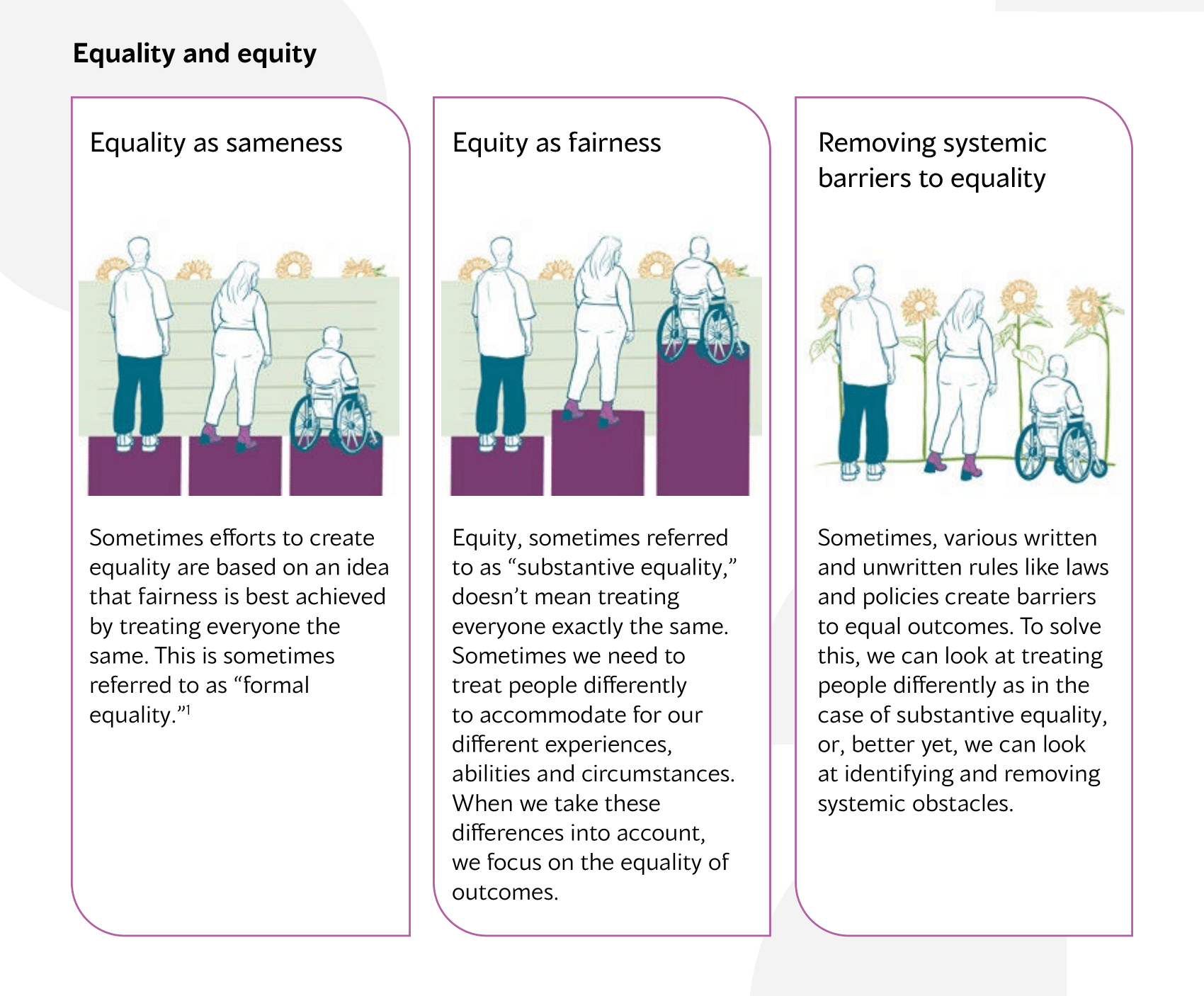
In hiring processes, employers often think that the best way to be fair is to treat everyone exactly the same: this is called equality or “formal equality.” While this sounds ideal on the surface, the problem is that not all people are treated the same in Canadian society. This is why equity (also called “substantive equality” by our courts) is required. Equity recognizes that to give different people the same access to opportunities, sometimes you have to treat them differently. This approach focuses on making the outcomes equitable, not just the process (as in formal equality).
From a hiring perspective, this means that employers must be aware of which groups of people have faced (and continue to face) discrimination and why, what barriers to employment these groups may face, and how employers can intentionally reduce or mitigate these barriers.
Although this toolkit focuses on employment equity initiatives that centre racialized and Indigenous people, it is important to remember that employment equity also extends to other disadvantaged and underserved groups such as people with disabilities, women, and gender-diverse people. As feminist Audre Lorde has noted, “we do not live single-issue lives”. It is important to recognize intersectionality, and understand that no one group is a monolith. There are differences in privilege and discrimination amongst racialized and Indigenous folks. Someone who experiences oppression and discrimination on a racial axis will experience it different than someone who experiences on a gender axis, and differently from someone who experiences it along both axes.
Keep this in mind as you read this toolkit, as similar principles and approaches apply to increasing inclusion for all such groups. You may find that after taking steps to increase employment equity in your organization for racialized and Indigenous people, that the groundwork has been laid to focus on authentic inclusion of other groups in the future.
Why Does Employment Equity in Hiring Matter?
"With knowledge comes understanding, with understanding comes wisdom, and with wisdom comes justice. And to have justice we must never forget how the world looks to those who are vulnerable. I will never forget the people who taught me to see the world through their eyes." The Hon. Rosalie Silberman Abella, 2009
You may be so caught up in the day-to-day of striving for fair hiring practices that you haven’t taken a step back to ask: Why is employment equity important? And why should our organization devote time and resources to these efforts? These questions may also be posed by donors, funders, or your board of directors as they assess the impact and sustainability of your organization’s diversity initiatives.
We engage in employment equity work so that excluded individuals and groups can fully participate in equal work opportunities, and so that workplaces are fair, just and welcoming for everyone. Not to mention organizational advantages like having more diverse perspectives to support decision-making, better alignment with the needs of deserving communities that your organization serves, and the opportunity to increase everyone’s empathy for people whose life experiences are different from theirs.
ENGO Worker Demographics Do Not Represent Canada's Racial and Ethnic Diversity
While employment equity in hiring concerns Canadian organizations in all sectors, there are special considerations we must keep in mind for the ENGO sector.
Recent ENGO-sector demographic research led by Nature Canada (Appendix A) confirms what we already suspected based on anecdotal evidence: the sector is dominated by White/European workers.
In summer 2024, Nature Canada in partnership with the Sustainability Network, circulated a survey amongst ENGOs in Canada. The survey, which reached nearly 200 nature and climate organizations across Canada, focused on racial representation among staff and paid leadership roles. Despite potential responder bias, the survey highlighted existing gaps in diversity within the ENGO sector. Nationally, respondents reported that Indigenous and racialized people made up only 22% of staff on average, compared to approximately 31% of the population. Representation in leadership roles dropped further to 14%—less than half of the national proportion. This underscores the need for continued work to achieve equity and inclusion, both in leadership recruitment and within organizational cultures.
Current ENGO demographics have not happened by accident. Historically, conservation efforts in Canada have focused on conserving lands and waters for White/European people to recreate and ‘escape’ from their everyday lives. These colonial attitudes mean that ENGO campaigns and programs have been largely geared to the needs and desires of White/European people.
Canada’s history has, and continues to, involve the displacement of Indigenous Peoples from the lands and waters they have stewarded for thousands of years. Historically, racialized people—particularly Black communities—have been overtly excluded from the conservation movement due to legacies of racism and colonialism; systemic underrepresentation; barriers to education and career advancement; racial stereotypes; lack of support for BIPOC-led initiatives; and environmental injustices disproportionately affecting these communities. Exploring these histories and their impacts is a vital part of understanding the barriers that racialized and Indigenous people face when entering and staying in the ENGO sector.
Given the high level of racial and ethnic diversity in Canada, ENGOs are significantly lagging in representation. But it’s not just a numbers game. ENGOs must complement increasing diverse representation with undertaking intentional work to decolonize their work environments to create truly welcoming, affirming workplaces.