
An annual event that brings together nature groups from across the country to talk with parliamentarians.
About the event
Nature on the Hill is an opportunity to showcase the strength of Canada’s nature community and spur the federal government to take action to halt and reverse the loss of nature. Delegates from nature groups have a chance to talk with MPs, Senators and Ministers about the issues that are most important to them.
Throughout the week of Nature on the Hill, nature groups representing a wide range of interests—from watershed alliances to birders to faith-based groups—participate in meetings with MPs, Senators and Ministers. The meetings are all in-person in Ottawa, but can sometimes be held in the ridings of an MP. That way, we ensure that voices from all corners of the country are brought to the table.
This year’s Nature on the Hill will happen on October 20-21, 2026. Scroll for an overview of Nature on the Hill over the past 8 years!

Hannah Dean, Director of Organizing at Nature Canada, addresses delegates to Nature on the Hill 2023
April 8, 2019
In the first year of Nature on the Hill (“Nature Day”), fifty delegates from 36 nature organizations across the country participated in 46 meetings with MPs from all parties. Delegates were pleased to be joined by Hector the Shark, who came a long way to speak up for ocean protection. We asked parliamentarians to double protection for nature in order to meet the government’s commitment to the United Nations Aichi Biodiversity Targets (to protect 17% of land and inland waters and 10% of marine and coastal areas by 2020).
One of the highlights was meeting with Minister for Fisheries and Oceans Jonathan Wilkinson and presenting a petition asking for protection of the Laurentian Whale passage, with signatures of almost 8,000 Canadians. This valuable marine area received full government protection just a few weeks later.
For many participants, it was their first time meeting with a federal politician, and they indicated in overwhelming numbers that they’d love to do it again. And so a tradition was born….

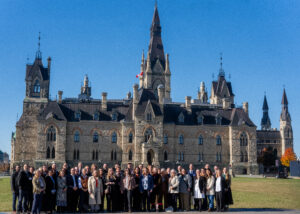
Nature Day participants (2019), including Hector the Shark, gather in front of Centre Block on Parliament Hill.
February 4, 2020
In this first year of COVID, we were lucky with the timing. We managed to wrap up both Nature on the Hill (Feb. 4) and our Nature-Based Climate Solutions Summit (Feb. 5 and 6) before the pandemic was officially declared. At Nature on the Hill Day 2020, we continued to press for achieving the Aichi targets and for the long-term budget investments required to meet these goals. We also urged the government to follow through on its commitment to play an active role on the world stage to ensure adoption of the 30×30 goal.
February 16-19, 2021
In the second year of the pandemic, we switched to virtual mode… with all its challenges. Despite struggles with the mute button and cats walking in front of screens, the fully virtual Nature on the Hill was a great success, with delegates from over 65 nature groups participating. The week featured a “Green Pandemic Recovery” town hall with 1000 attendees, with guests Jonathan Wilkinson (Environment and Climate Change Minister) and Bernadette Jordan (Fisheries and Oceans Minister). We continued to press the budget issue, submitting over 20,000 letters from Canadians urging Finance Minister, Chrystia Freeland to ensure protected areas would be a budget priority.

Nature on the Hill 2021: the virtual edition
February 14-18, 2022
The vision for this year: a nature-positive future. Seventy-five nature groups convened with parliamentarians to ask for a comprehensive action plan— informed by Indigenous Peoples, experts and local communities—to halt and reverse nature loss by 2030. Our Nature Network partner, “For Peat’s Sake,” was featured on CBC News, and we held several roundtable discussions with VIPs and nature groups including Minister Guilbeault; Ron Hallman, the CEO of Parks Canada; and Tony Maas, a Senior Policy Advisor with the Prime Minister’s office.
And we started looking ahead to the U.N. Biodiversity Conference (“NatureCOP”) to be held in Montreal in December 2022, hoping aloud that Canada would show leadership on the world stage…
March 7 – 10, 2023
And yes, NatureCOP turned out to be a success. Negotiations there resulted in the Global Biodiversity Framework, which committed the signatories to protecting thirty percent of lands and waters by 20230. To meet the goals of the Framework, Canadian Environment Minister Steven Guilbeault promised to deliver a National Biodiversity Strategy and Action Plan (NBSAP). We sent over 10,000 letters demanding that the government make good on its promise.

Nature on the Hill participants, including Nature Canada Staff, in 2024
April 29 to May 2, 2024
In 2024, it was all about a biodiversity action plan.
At the 2024 Nature on the Hill, participants worked to ensure that cabinet ministers, parliamentarians and senior officials understood the importance of delivering a strong biodiversity strategy and action plan. And that work paid off! In June 2024, the federal government released the 2030 Nature Strategy and Nature Accountability Bill. The Nature Accountability Bill will hold governments accountable for progress towards the targets of the Strategy. Although the bill has not yet been passed, Nature Canada is working to ensure that will be a priority for the new government.
October 27-29, 2025
Well… a lot happened in 2025. Following a spring election that saw the Liberals re-elected with a minority government under new Prime Minister Mark Carney, the political landscape shifted significantly. With the government focused on “nation-building” and unity, Nature on the Hill 2025 seized the moment to position nature as Canada’s greatest unifying force.
This year’s event was our biggest yet, described by staff as the “Super Bowl” of advocacy. Over 70 nature groups from across the country gathered in Ottawa with a clear message: Invest in Nature.
Delegates participated in over 50 meetings with MPs, Senators, and Ministers, urging them to back the previously released 2030 Nature Strategy with the funding required to make it a reality. We framed our requests around investing in Canada’s identity, protecting nature as a foundation for a strong society, and building a restoration economy.
A major highlight was engaging with Canada’s first-ever Secretary of State for Nature, Nathalie Provost, who joined us at our reception to emphasize that conservation requires “nature building projects,” not just concrete and steel. We also brought nature to the Senate and the House of Commons… read more here.
Despite the uncertainty of looming budget cuts across federal departments, the energy on the Hill was electric. We left feeling energized, having made the case that in a time of division, nature is the one thing that brings us all together.
October 19-21, 2026
Nature Canada’s 8th Nature on the Hill event was a great success, with over 70 participants representing nature groups from all across the country coming to discuss with decision-makers how a Canada worth building puts Nature up front.
The groups who came to Ottawa this week exemplify our shared desire to protect and conserve the nature we all love and appreciate. With every province and the Yukon and Nunavut represented in meetings, participants met with over 50 legislators to say in a unified voice that nature is not red tape.
To build Canada putting Nature up front, we asked for your help to:
→ Amend Bill C-39 to keep environmental safeguards and create certainty for investment;
→ Adopt the Mitigation Hierarchy framework to avoid and minimize harmful impacts to nature before having to restore and offset them; and
→ Invest strategically in nature to drive prosperity and competitiveness.
Parliamentarians wanted to know more about how we can get there. They asked how we can make Bill C-39 better, so here is Nature Canada’s top 4 suggestions:
- Keep protected areas protected – make sure that sensitive areas are not affected by any changes to legislation from C-39;
- Add in the Mitigation Hierarchy – add a clause that states that a process of avoid, minimize, restore, and offset only as a last resort be followed;
- Amend the sunsetting clause – instead require a comprehensive review by House and Senate committees, informed by independent assessments, every five years (similar to the Fisheries Act);
- No bulldozing before approval – remove provisions that allow for early-work orders, meaning construction should not begin before environmental approvals are complete